

Youth Manifesto for Digital Rights
January 2026
Author: Forus, Fundación Karisma and Nilā Facilitation
The Youth Manifesto for Digital Rights was developed through a months-long process within the Youth Voices for Digital Rights programme. The programme aimed to involve young people in discussions shaping today’s digital environment.
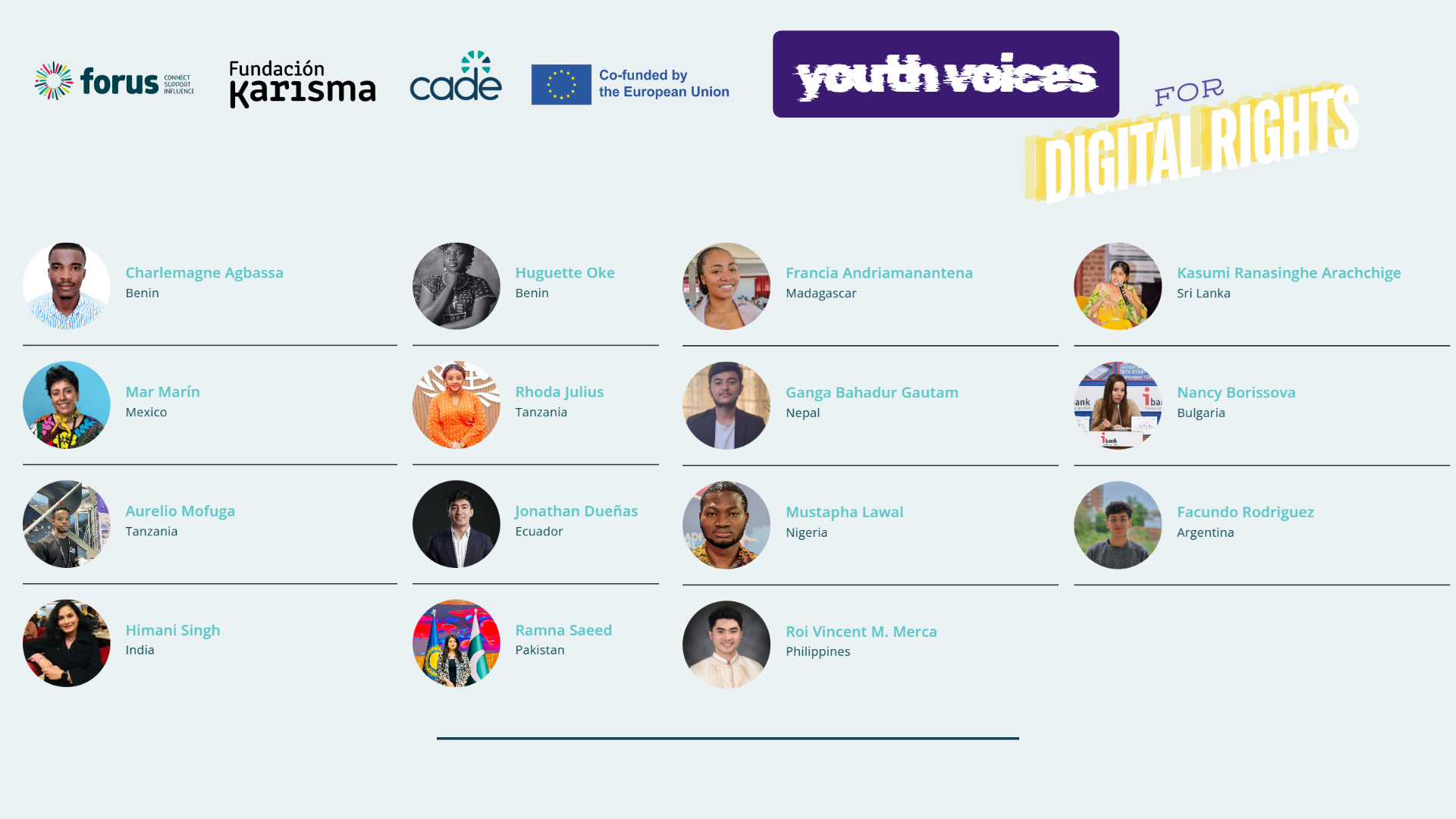
The initiative was implemented by the CADE consortium, led by Forus with support from Karisma, and brought together 15 young advocates from Africa, Asia, Latin America, and Europe. Participants worked on issues including digital rights, equality, countering misinformation, language preservation, mental health, and youth participation.
Young people are the internet’s largest user group, but are often the furthest away from internet governance forums. The Youth Voices for Digital Rights project convened fifteen young activists in a multiregional, multilingual space to learn, share, and co-create solutions to today’s digital challenges.
Youth Voices for Digital Rights
Over the course of four online sessions, participants developed a common language about digital rights, learned about multistakeholder internet governance, and shared their unique perspectives for change. With the support of a team of technical experts, storytellers, and facilitators, participants developed a Youth Manifesto for Digital Rights. This manifesto invites governments, corporations, donors, civil society, and other internet governance decision-makers to take concrete action towards their vision for a better digital future.
VISION
We envision a digital future where the internet is participatory, affordable, transparent, safe, inclusive, and accountable.
CALLS TO ACTION
- Ensure internet governance forums enable meaningful and decision-shaping participation by young people.
- Fund youth-led internet governance initiatives, engagement processes, and meaningful participation.
- Amplify the perspectives of global majority regions in internet governance forums and decision-making processes.
- Ensure high-quality, reliable access to the internet is affordable to all.
- Increase investments in media literacy so that internet users are better informed about their participation in digital spaces, especially as the amount of information on the internet continues to grow.
- Push for greater transparency and accountability from corporations in the collection, use, and management of personal data in the digital space, adopting a human rightsbased approach that goes beyond existing national regulations.
- Ensure algorithmic clarity and empower users to make informed decisions. Require platforms to clearly explain why they display certain content and provide people with real tools to control their online experience, preventing manipulation of attention and biases that limit the diversity of information.
- Resist techno-optimism: Technology alone cannot solve structural social, political, or economic problems – the human component is necessary for developing long-lasting solutions that centre the people affected.
- Strengthen existing mechanisms and develop new ones to further protect people’s rights in the digital space, including but not limited to data and privacy, freedom of expression, and online security. These mechanisms should be resourced, use evidence-based approaches, and be able to effectively enforce laws and policies.
- Protect historically marginalised communities from harm and discrimination by creating safer digital spaces through regulations and inclusive policies, including against mass surveillance, internet shutdowns, and abuse of digital tools by states and corporations.
- Adapt and localise decision-making, strategies, and technology deployment to serve the nuances of different local contexts, especially across the global majority regions and diverse language communities.
- Use the internet as a tool to address structural inequities and not worsen them, including but not limited to income, gender identity and expression, disability, language, faith, race, and geography.
- Recognize and protect rights in the digital economy. Establish frameworks that protect people who use the internet as a means of work and livelihood, guaranteeing fair conditions and preventing job insecurity resulting from arbitrary changes to platforms or their terms of service.
- Leave no community behind.
- Ensure people have accessible ways to challenge digital harms, platform decisions, and rights violations, with effective mechanisms for justice and remedy.
- Ensuring sustainable digital development accountable to current and future generations. Prioritizing environmentally friendly infrastructure and devices that reduce energy consumption and the generation of technological waste, so that digital advances do not harm the relationship with the environment for future generations.
This publication was co-funded by the European Union. Its contents are the sole responsibility of the author and do not necessarily reflect the views of the European Union.
