

CADE Newsletter – January/February 2026
IN FOCUS
From stories to shared commitments: Youth Voices for Digital Rights concludes with a manifesto launch
Over the past six months, young advocates from Africa, Asia, Latin America, and Europe came together around a simple but demanding task: to tell their own stories about digital rights in their communities, and to link those stories to the systems that shape the internet globally.
They compared experiences across contexts: biometric voter registration in Nigeria, internet shutdowns in Nepal, connectivity gaps in Argentina, online discrimination in India, and cybercrime legislation in Pakistan. Different settings, different pressures. Yet the pattern was familiar: digital decisions taken elsewhere often land locally, with uneven consequences.
Rather than treating these issues as abstract policy debates, the group grounded them in lived reality. What does algorithmic transparency mean in practice? How does digital inclusion look in a rural district, or in a marginalised urban community? Who benefits when digital systems are introduced, and who is left navigating new risks?
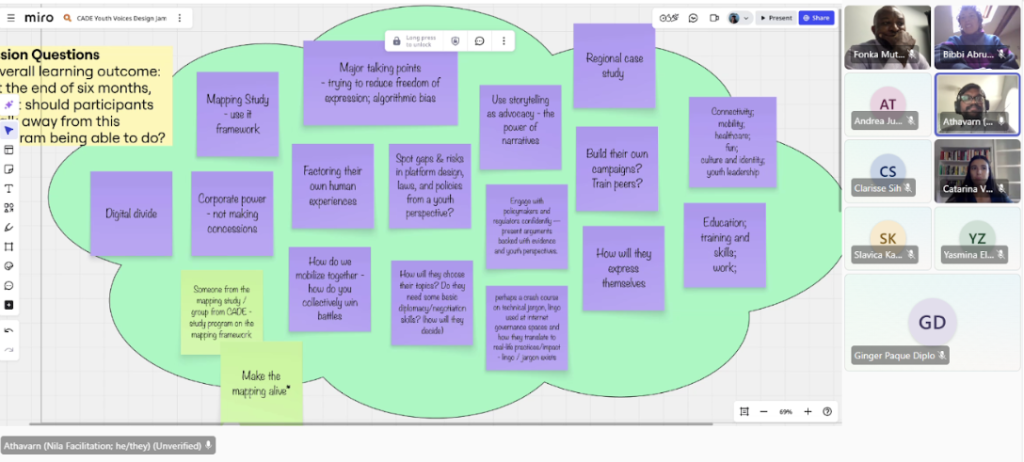
Facilitator Athavarn Srikantharajah moderating the Design Jam session on 22 September 2025 for the CADE Youth Voices for Digital Rights
With guidance from experienced trainers and organisers as part of the Youth Voices for Digital Rights programme, participants turned these questions into public-facing work, articles, podcasts, and videos that move from personal experience to structural analysis. Each piece begins with something concrete: an election, a classroom, a community affected by data extraction, a platform shaping public debate. From there, it steps outward, connecting the dots to governance frameworks and corporate practices.
The initiative concluded on 12 January 2026 with a virtual open house, where participants presented their work and opened the discussion to a broader audience across regions and languages.
[Video] Data colonialism in Mannar: When data is extracted, communities pay the price – by Kasumi Ranasinghe (produced in collaboration with the Happy Voice Hub and published in December 2025) – explores how data extraction, surveillance, and digital decision-making are reshaping lives on Mannar Island, Sri Lanka
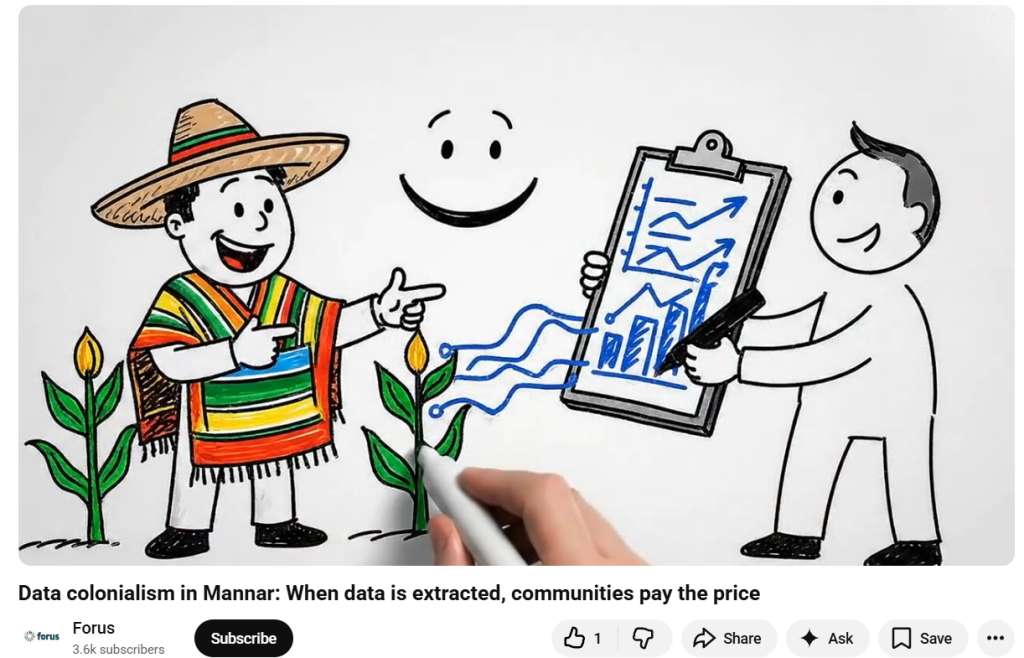

[Video] How PECA is Redefining Free Speech in Pakistan – by Ramna Saeed – examines how cybercrime legislation can restrict freedom of expression. The video was published in January 2026.
Launching the Youth Manifesto
During the same session, the group launched the Youth Manifesto for Digital Rights, a collective statement shaped by the concerns that surfaced throughout their exchanges.
The manifesto brings together their perspectives on access, power, responsibility, and accountability in digital spaces. It addresses who shapes the rules of the internet, what affordable and reliable connectivity means in practice, how companies manage personal data and algorithmic systems, how communities respond to surveillance or shutdowns, and what recourse exists when harm occurs.
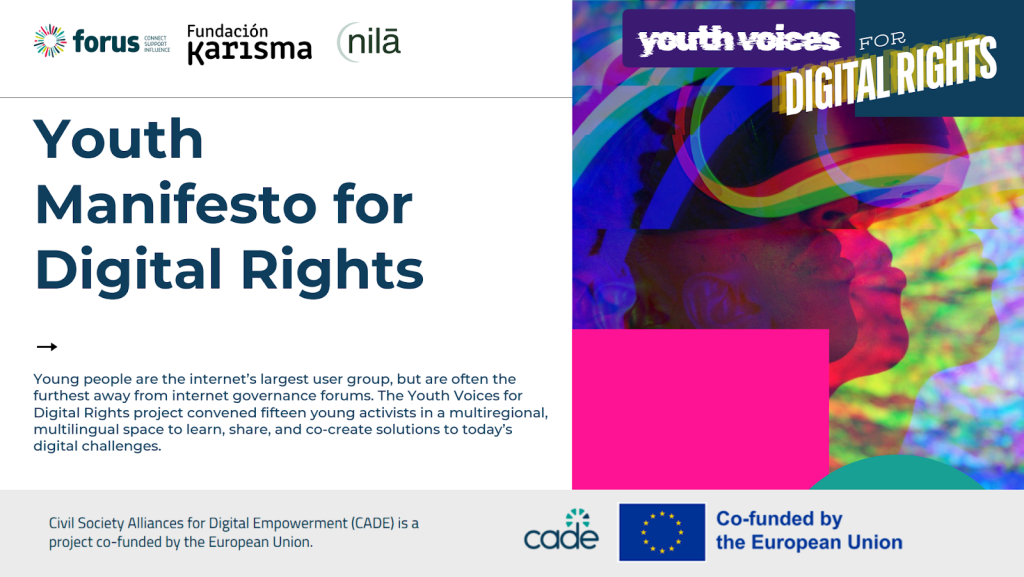
Published in English, French, and Spanish, the manifesto is designed to travel across institutions, regions, and policy spaces. It speaks to governments, companies, donors, and civil society, and resonates with other young people navigating similar realities in different parts of the world.
What began as a series of conversations ended as both a set of stories and a shared document, a grounded contribution to digital governance debates rooted not in theory alone, but in lived experience.
🌍 UPDATES
New Global North–Global South Working Group launches
CADE is launching a new Digital Governance Working Group designed to strengthen collaboration between civil society organisations from the Global North and Global South.
The Working Group, led by ECNL and Forus, is structured as an ongoing space for coordination on human-centric internet governance. Through five meetings scheduled for 2026, organisations working on digital rights, digital inclusion, internet governance, and AI policy will exchange knowledge, identify shared priorities, and explore opportunities for joint action.
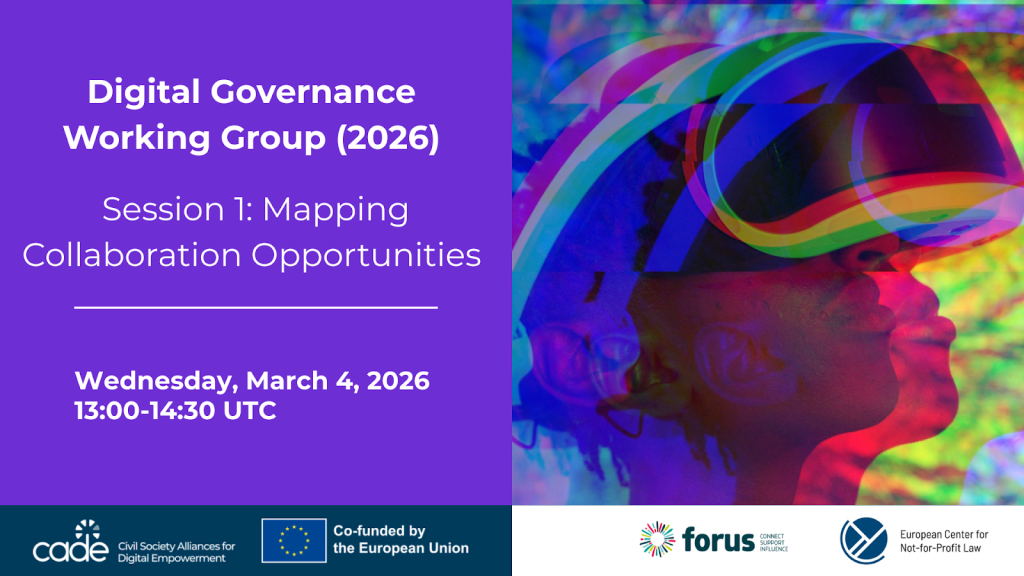
The first meeting, Mapping Collaboration Opportunities, will take place on 4 March 2026, from 13:00 to 14:30 UTC, online with interpretation in English, French, and Spanish.
The opening session will focus on identifying concrete areas for collaboration during the year ahead. Participants will share current initiatives, highlight organisational strengths, and map opportunities for coordinated engagement, with outcomes captured in a shared online document to support follow-up. Registration is open.
Building depth in digital policy – second iteration coming soon
More than 60 civil society organisations are engaged in CADE’s Capacity Development Programme – developed and delivered by Diplo – since December.
What began with a technical grounding in how digital policy works has now moved into more advanced terrain. Participants are working through internet infrastructure, cybersecurity, and AI governance, unpacking how these layers connect to regulation, rights, and power. The sessions are less about abstract definitions and more about understanding how systems function, who influences them, and where civil society can intervene. The focus will soon shift towards negotiation and coalition-building, translating policy knowledge into practical engagement skills.
The scale of participation and sustained engagement over recent months points to something broader: a clear need for structured, in-depth support for civil society actors navigating digital policy processes.
A new call for applications will be launched shortly. Details on eligibility, timeline, and how to apply will be shared in the coming weeks.
Your Clicks, Your Rights: The complete series
When Your Clicks, Your Rights was introduced last October, it marked the start of a 10-episode multilingual series unpacking how digital technologies and policies shape human rights, equity, and participation. The whole series is now available.
Developed by Forus, the short explainer videos translate key findings from CADE’s Mapping and Baseline studies into accessible, practical examples. Across English, Spanish, French, and Portuguese, the episodes explore digital rights and civil society participation, access and affordability gaps, cybersecurity and civil liberties, AI governance, gender justice online, regional internet governance forums, infrastructure inequalities, and cybercrime laws in the MENA region.

One of the ten episodes: Fernan Rodriguez (Forus) explains why access and affordability still matter.
Several episodes build directly on partner research produced during the project’s first year, including Karisma’s analysis of connectivity gaps in Latin America, KICTANet’s study on African civil society engagement in internet governance forums, and SMEX’s work on cybercrime legislation. In doing so, the series extends the reach of these studies beyond specialist audiences.
All episodes are available on the CADE Observatory and on YouTube.
📅 COMING UP
The global policy calendar for March and April
March will be a busy month in global internet governance.
ICANN85 (7–12 March, Mumbai & online) will bring together the global domain name community for policy discussions and cross-community sessions. For civil society organisations tracking DNS governance, rights implications, and multistakeholder processes, this is one of the year’s key entry points.
A week later, IETF 125 (14–20 March, Shenzhen & online) will focus on the technical standards that shape how the internet actually works. While often seen as highly technical spaces, IETF processes increasingly intersect with questions of infrastructure, security, and rights.
The Internet Governance Forum (IGF) 2026 has opened its Call for Thematic Inputs. Stakeholders across regions are invited to submit views on emerging digital governance challenges, including AI, cybersecurity, data governance, rights, access, and digital cooperation. Deadline for thematic inputs: 8 March 2026 (23:59 UTC). The official IGF 2026 landing page is now live and will serve as the central hub for updates and engagement.
April shifts attention towards broader digital rights dialogue. The Digital Rights and Inclusion Forum (DRIF 2026) will take place in Abidjan on 14–16 April, convening policymakers, civil society, technologists, and researchers working on digital inclusion and governance across the Global South.
Applications are open for the 2026 Kenya School of Internet Governance, organised by KICTANet. The self-paced online course runs from 22 April to 15 May 2026 and builds foundational knowledge in internet governance and digital policy for civil society actors, human rights defenders, students, and policymakers. Application deadline: 10 April 2026.
Need support to engage?
If your organisation is considering engaging in ICANN, IETF, or ITU processes but is unsure where to start, CADE offers tailored support. This can include:
- Guidance on how to begin engaging in ICANN, IETF, and ITU processes
- Support in navigating how these forums function
- Financial and logistical assistance for participation in selected meetings
- Connections to civil society coordination groups
- Advice on preparing policy and position papers
Contact us at cade@diplomacy.edu with the subject line Support for ICANN, IETF, and ITU engagement to explore options.
CADE project programmes are carried out as part of the Civil Society Alliances for Digital Empowerment (CADE) project and are co-funded by the European Union. The views expressed in these initiatives are those of the authors and do not necessarily reflect the official position of the European Union.
