

On 31 May 2024, the Civil Society Alliances for Digital Empowerment (CADE) project was launched at the WSIS+20 Forum High-Level Event in Geneva. Dr Stephanie Borg Psaila, CADE project coordinator at DiploFoundation, introduced the organisations collaborating on the project and their representatives: Dr Jovan Kurbalija of DiploFoundation, Karolina Iwańska of the European Center for Not-for-Profit Law, Mavalow Christelle Kalhoule of Forus, Ashnah Kalemera of CIPESA, Dr Grace Githaiga of KICTANet, Nipunika Ruhunage of Sarvodaya Fusion, Abed Kataya of SMEX, Andrew Molivurae of PICISOC and Pilar Sáenz of Fundación Karisma.
The session, Enhancing CSO participation in global digital policy processes: Roles, structures, and accountability, examined why civil society organisations continue to face difficulties when engaging in internet governance and technical standard-setting.
Participants identified high membership and travel costs, complex procedures, limited access to technical knowledge and the need for sustained funding as key barriers. They also noted that participation remains disproportionately concentrated among organisations from the Global North, while organisations from the Global South and groups representing marginalised communities often have fewer opportunities to contribute.
The discussion stressed that civil society brings important expertise on human rights, equality, accessibility, inclusion and the societal effects of technology. However, civil society is sometimes defined too narrowly within standard-setting bodies, leaving limited space for human rights organisations and community-based groups.
Participants also cautioned that formal access does not necessarily lead to meaningful participation. Organisations need sufficient knowledge, resources and long-term institutional support to follow complex processes, submit evidence and influence decisions. At the same time, internet governance and standard-setting bodies need to create clearer and more accessible participation pathways.
The session considered opportunities for civil society engagement in institutions such as ITU, ICANN and the IETF. While some mechanisms are open, membership requirements, fees, and the cost of accessing standards can restrict participation. Participants called for lower financial barriers, greater public access to key standards, and stronger integration of human rights considerations into technical processes.
Examples from different regions demonstrated how civil society organisations can provide local knowledge, represent affected communities and connect international digital policy discussions with their practical consequences. Participants emphasised the importance of the inclusion of civil society from the outset of policymaking and standard-setting processes.
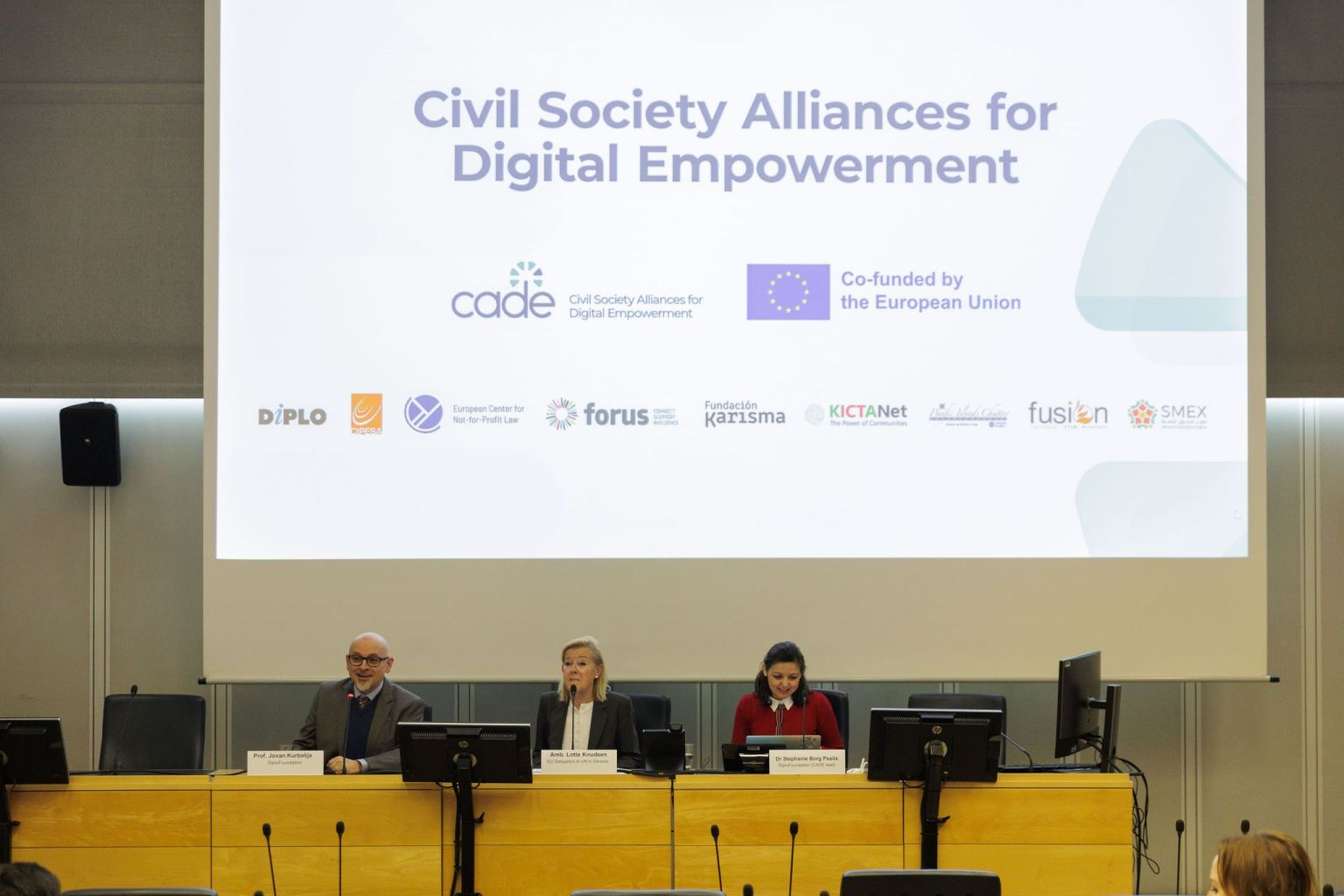
The four-year CADE project, co-funded by the European Union and led by DiploFoundation, aims to address these challenges through tailored training, stronger cooperation among civil society organisations and constructive dialogue with policymakers. The Geneva session provided an early platform to present the project’s objectives and identify practical steps towards more inclusive and geographically balanced participation in global digital governance.
To learn more about the launch of the programme, read the press release: https://cadeproject.org/press-release-launch-of-the-civil-society-alliances-for-digital-empowerment-cade-project/