

Skip to content
CADE – Civil Society Alliances for Digital Empowerment Logo CADE – Civil Society Alliances for Digital Empowerment Logo
  • Topics
  • Policy updates
  • In focus
  • Resources
  • Actors
  • Policy calendar
  • About
    • About project
    • Our mission
    • Latest news & events
    • Who are we?
    • Mapping & baseline
    • Newsletters
    • Join us
  • Partners’ login
  • Topics
  • Policy updates
  • In focus
  • Resources
  • Actors
  • Policy calendar
  • About
    • About project
    • Our mission
    • Latest news & events
    • Who are we?
    • Mapping & baseline
    • Newsletters
    • Join us
  • Partners’ login
  • Topics
  • Policy updates
  • In focus
  • Resources
  • Actors
  • Policy calendar
  • About
    • About project
    • Our mission
    • Latest news & events
    • Who are we?
    • Mapping & baseline
    • Newsletters
    • Join us
  • Partners’ login

CADE at Pacific IGF 2025 – Community engagement in the Pacific

Previous Next

CADE at Pacific IGF 2025 – Community engagement in the Pacific

The Pacific IGF 2025 in Apia, Samoa, brought together regional stakeholders to discuss digital inclusion, safety, and community-led approaches to internet governance in the Pacific.

CADE participated in the Pacific Internet Governance Forum 2025, held at the National University of Samoa in Apia from 30 June to 4 July 2025, with two sessions focused on community engagement and digital awareness. Organised under the theme Digital Inclusion and Safety, the forum convened stakeholders from across the Pacific region, as well as participants from New Zealand and Australia, to exchange experiences and address emerging internet governance challenges. A total of 165 participants attended the CADE sessions, including 46 women and 119 men.

On 2 July, Session 5 addressed Community Engagement and Awareness. Sakaio Manoa of the Forum Fisheries Agency presented the organisation’s progress towards ISO 27001:2022 certification, outlining the relevance of information security standards for institutional resilience. Kenneth Katafono of TraSeable Solution followed with a presentation on leveraging private sector innovation to support digital inclusion in Pacific agriculture.

Session 8 Community Engagement and Awareness 2, held on 3 July, continued the focus on community engagement. Speakers from the Fiji National University, Swaran Ravindra, Asutosh Maharj, and Elenoa Naivalu, shared experiences in using virtual reality and digital skills toolkits to strengthen technical and vocational education and foundational digital literacy. Vivian Maidaborn, CEO of InternetNZ, discussed the role of the technical community in supporting multistakeholder cooperation. The session concluded with a roundtable on the WSIS+20 process and its implications for Pacific Island states, with contributions from representatives of the Internet Society and the Australian Department of Infrastructure.

Across both sessions, participants emphasised the importance of localised, community-led digital initiatives, targeted digital literacy programmes, and inclusive engagement strategies. Universities were highlighted as key actors in outreach and research, while discussions on trust and transparency focused on the use of ethical technology and transparent data practices. The forum also featured side events, including the APNIC Technical Workshop, Australian Government internet governance training, the Pacific Multistakeholder IGF, and the inaugural Pacific Youth IGF, all of which reinforced the emphasis on inclusive participation and capacity building across Pacific communities.
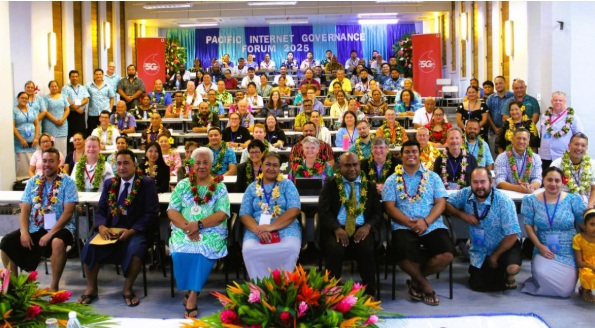
Hon. Afioga Fiamē Naomi Mataʻafa, Prime Minister of Samoa, Ms Sarai Tevita, PICISOC Board Chair, and Mr Andrew Molivurae, Pacific IGF Chair, with the Pacific IGF 2025 participants

By Boris Begovic|2025-12-30T07:25:17+00:00June23 6, 2025|Latest news|Comments Off on CADE at Pacific IGF 2025 – Community engagement in the Pacific

Civil Society Alliances for Digital Empowerment (CADE) is a project co-funded by the European Union.

Civil Society Alliances for Digital Empowerment (CADE) 2024. All rights reserved.

This website is co-funded by the European Union. Its contents are the sole responsibility of CADE and do not necessarily reflect the views of the European Union.

Web accessibility | Privacy policy

Page load link
We use cookies to improve your experience on our website
By clicking 'Accept' you consent to all cookies in accordance with our Cookie Policy and Privacy Policy. We have updated our Privacy policy effective 27 April 2020 to reflect our expanding online tools and presence.More info

Accept No, thanks
Privacy & Cookies Policy

Privacy Overview

This website uses cookies to improve your experience while you navigate through the website. Out of these, the cookies that are categorized as necessary are stored on your browser as they are essential for the working of basic functionalities of the website. We also use third-party cookies that help us analyze and understand how you use this website. These cookies will be stored in your browser only with your consent. You also have the option to opt-out of these cookies. But opting out of some of these cookies may affect your browsing experience.
Necessary
Always Enabled
Necessary cookies are absolutely essential for the website to function properly. This category only includes cookies that ensures basic functionalities and security features of the website. These cookies do not store any personal information.
Non-necessary
Any cookies that may not be particularly necessary for the website to function and is used specifically to collect user personal data via analytics, ads, other embedded contents are termed as non-necessary cookies. It is mandatory to procure user consent prior to running these cookies on your website.
SAVE & ACCEPT
Go to Top