
CADE’s July–August round-up
| ⭐ IN FOCUS |
AI for good, but for whom? Rethinking AI governance through a Global Majority lens
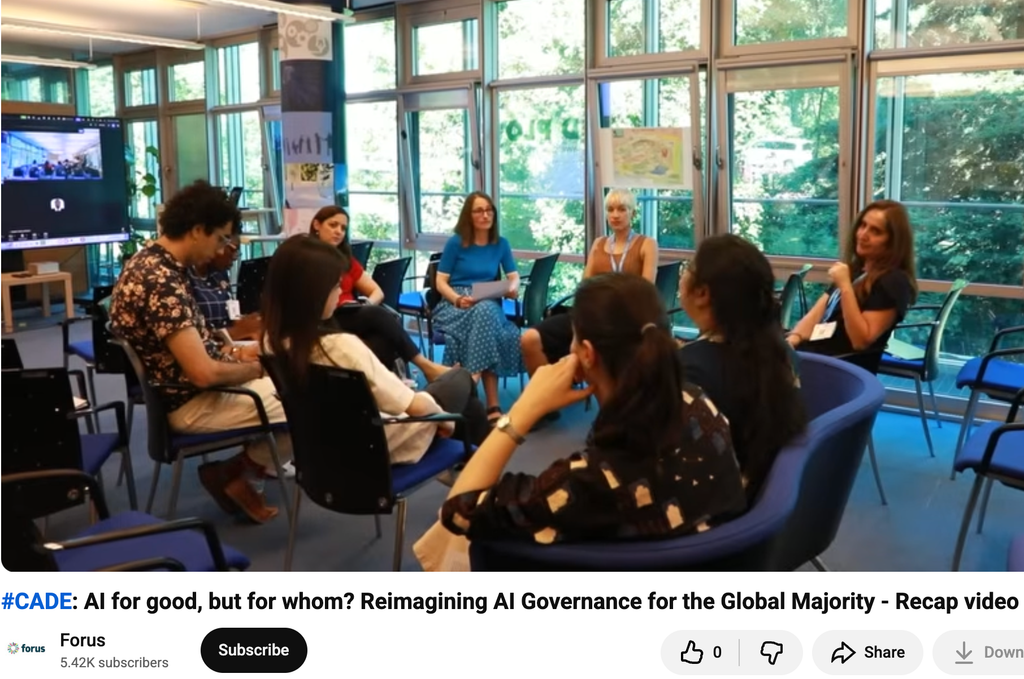
AI is often presented as a force for good. But good for whom? And who gets to decide? This question shaped CADE’s policy lab AI for good, but for whom?, held in Geneva on 9 July on the sidelines of ITU’s AI for Good Global Summit and WSIS Forum 2026.
Organised by the Arab Reform Initiative, Pollicy, Women of Uganda Network (WOUGNET), Women in Internet Governance, and the Center for AI Ethics and Governance in Africa (CAIEGA), with the support of Diplo, ECNL, and Forus, the session brought together civil society, policymakers, technologists and other stakeholders to explore what AI governance looks like when the realities of the Global Majority are placed at the centre.
Rather than beginning with policy recommendations, the policy lab put people into situations where governance choices had to be made. Four scenarios became four distinct entry points to the same question: What happens when the promises of AI meet the people and systems that must live with its consequences?
The first scenario took apart the familiar story of automation. Behind an AI system that appears to replace human work are often people labelling data, moderating content and training models, frequently through layers of platforms and subcontractors. The question quickly shifted from what AI can automate to who is doing the work, who benefits from it, and who is responsible for those workers.
A second scenario moved the focus from labour to regulation. AI governance models developed in the Global North are increasingly finding their way into policy frameworks elsewhere, but a regulatory model that works in one context does not necessarily translate into another. Different institutional capacities, economic structures and informal economies change what regulation can achieve. Localising AI governance is therefore not simply a matter of adapting terminology; it means asking who gets to shape the rules in the first place.
The remaining scenarios brought the stakes even higher: AI in warfare and security, and AI-assisted decisions that can directly affect people’s lives. Here, accountability became harder to pin down. When responsibility is spread across governments, technology companies, developers and contractors, who answers when an AI-supported decision causes harm? And what happens when the person affected has no meaningful way to challenge it or seek redress?
Putting these questions into concrete scenarios made tensions visible that can easily disappear in abstract policy debates. It also demonstrated the value of sandboxing as a methodology for civil society: Rather than debating regulation in the abstract, people can test how different approaches hold up when confronted with competing interests, imperfect information and real-world consequences.
Across the four scenarios, one idea kept resurfacing: AI governance cannot afford to be purely reactive. By the time a harm is visible, the systems, markets and power relationships behind it may already be deeply embedded. Anticipating those consequences – and creating space for the people most affected to have a voice in shaping the rules – is part of making AI genuinely work for the public good. Watch the recap video produced by CADE partner Forus.
Learning from civil society’s experience
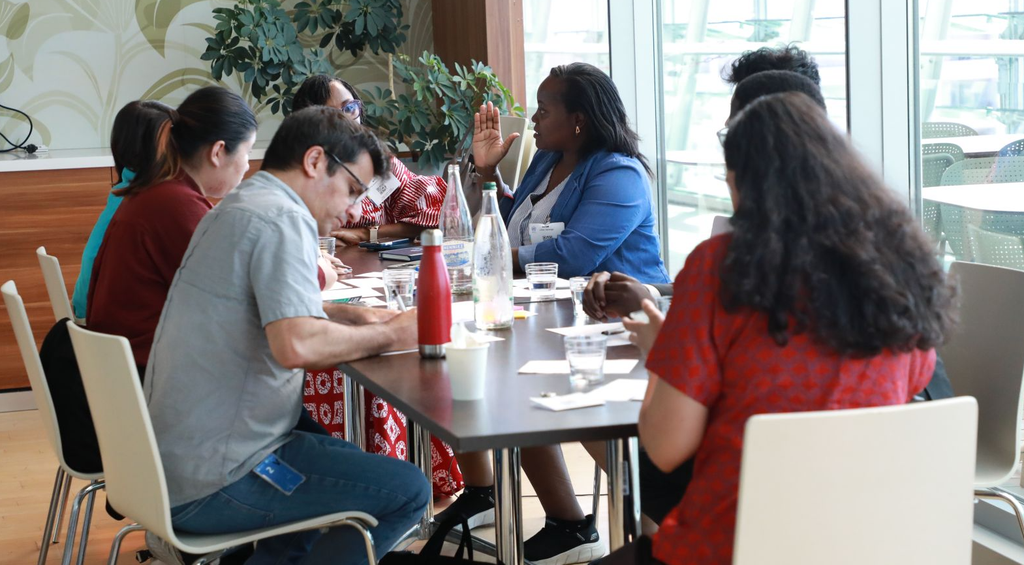
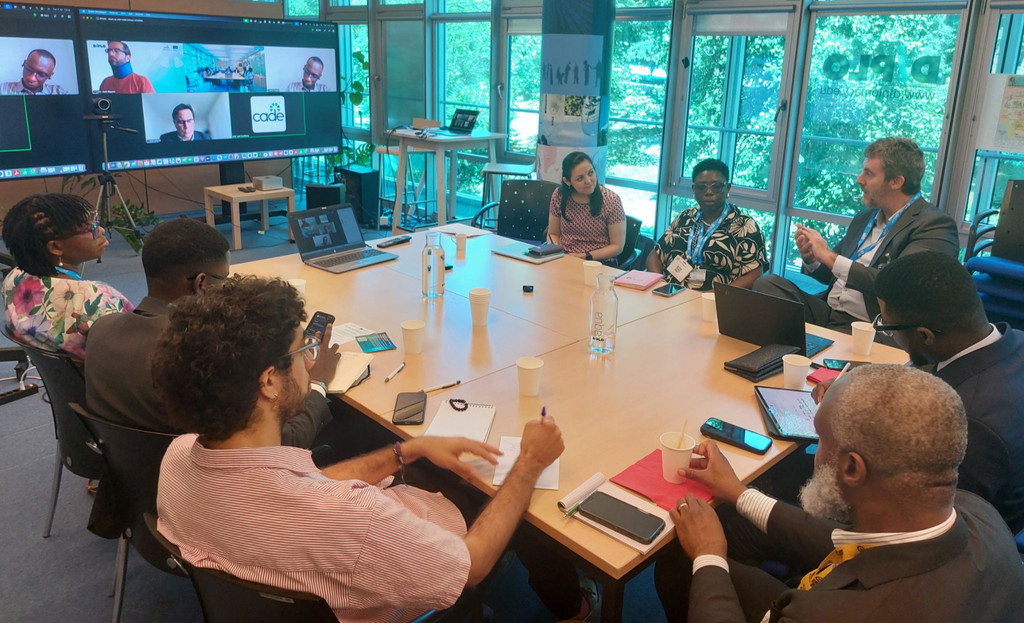
Two days earlier, Diplo organised a Learning and Sharing session as part of CADE, bringing together CSOs with experience of engaging governments and the private sector in digital policy and internet governance.
The conversation moved between two seemingly different approaches: building relationships with governments and knowing when to challenge them. Long-term engagement, government and parliamentary champions, and advocacy adapted to local political realities can open doors. Strategic litigation can provide another route when dialogue fails, particularly around internet shutdowns and digital rights violations.
One lesson these approaches shared was that change rarely happens in isolation. National networks, regional partnerships and international coalitions can amplify local advocacy, coordinate legal action and create pressure that individual organisations cannot generate alone.
Together, the two Geneva sessions pointed to complementary dimensions of effective civil society engagement: understanding how emerging technologies redistribute power and building the relationships, coalitions, and strategies needed to influence the systems that govern them.
| 🌍 UPDATES & RESOURCES |
Pacific voices in digital governance
July brought several opportunities for Pacific stakeholders to reflect on the region’s digital priorities and strengthen collaboration across communities, sectors, and countries.
During the Digital Transformation Summit 2026 in Papua New Guinea, CADE partner PICISOC hosted a Mini Pacific Internet Governance Forum (PacIGF) on 22 July, bringing together stakeholders to reflect on the evolution of internet governance in the Pacific and identify priorities for future action. Discussions focused on connectivity, digital inclusion, youth participation, digital skills, cybersecurity, and regional cooperation, and considered how PICISOC and PacIGF can continue to support stronger Pacific participation in regional and global digital policy processes.

The conversation continued later in the month during the Tonga Women in ICT (TWICT) Pacific Digital Dialogue Series, with PICISOC (through Sarai Tevita’s participation) joining regional leaders to discuss women’s leadership in digital transformation. Drawing on experiences from across the Pacific, the dialogue explored the role of digital literacy, inclusive leadership, and locally led initiatives in ensuring that digital development responds to the needs of Pacific communities.
From digital progress to digital rights: Uganda and Zimbabwe face a key UPR moment
As Uganda and Zimbabwe head into their fourth-cycle Universal Periodic Reviews (UPRs) at the UN Human Rights Council, joint stakeholder submissions by CADE partner CIPESA and its partners show that digital progress still needs to be matched by stronger protections for online rights.
Both countries have expanded connectivity, digital services, and regulatory frameworks since their previous reviews. Uganda is also recording important court decisions against restrictive provisions of the Computer Misuse (Amendment) Act, 2022, and criminal defamation, while Zimbabwe has expanded broadband access, licensed satellite internet services, and introduced new freedom of information and data protection measures.
Yet these gains sit alongside persistent restrictions on online expression and civic participation. Journalists, activists, opposition actors, artists, comedians, human rights defenders, and social media users continue to face arrest, prosecution, intimidation, and harassment, while broadly worded communication offences, online media controls, and national security provisions provide space for censorship and self-censorship.
The Uganda submission by CIPESA, APC, and WOUGNET, and the Zimbabwe submission by ZLHR, the University of Birmingham, PALU, DRAA, and CIPESA, therefore, emphasise the same urgent challenge: Expanding digital access really needs to be accompanied by legal and institutional reforms that ensure people can use digital technologies safely, freely, affordably, and without undue interference.

| 📚 RESOURCES |
Mapping internet shutdowns and censorship across Latin America
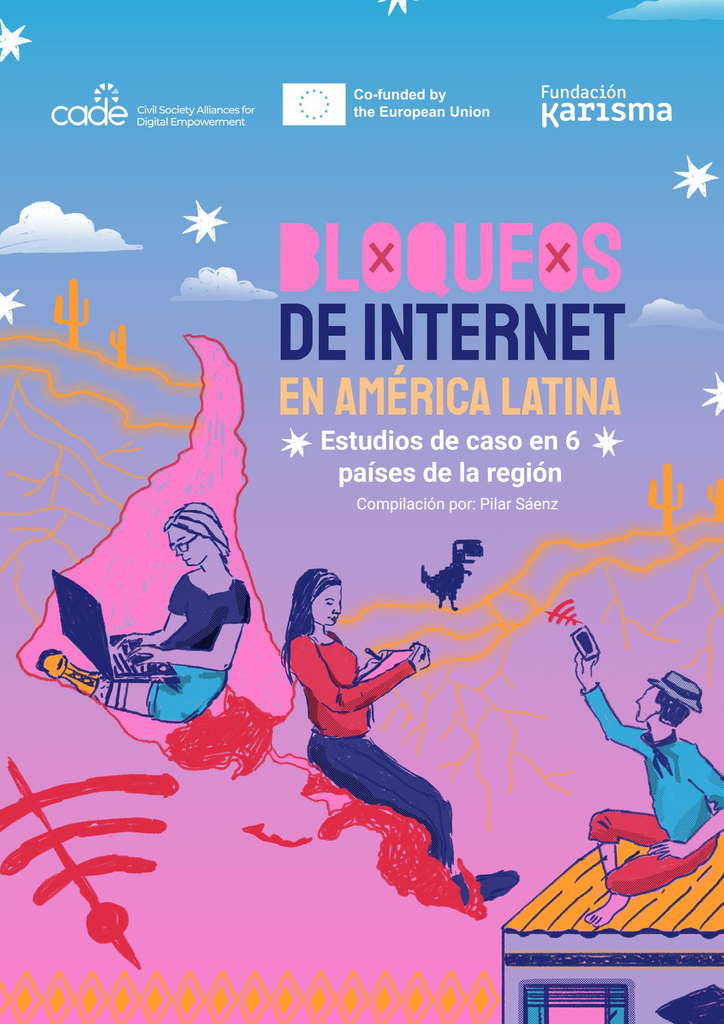
Internet shutdowns and online blockages continue to shape the digital rights landscape across Latin America and the Caribbean. While the circumstances differ from country to country, a common pattern emerges. Restrictions on connectivity are often imposed during periods of political tension, social unrest, elections, or public debate. The result is reduced access to information and fewer opportunities for civic participation.
To better understand these disruptions, CADE partner Fundacion Karisma brought together researchers and civil society organisations from across the region to document experiences from six countries. The resulting report, ‘Cortes y bloqueos de internet en América Latina: Estudios de caso en 6 países de la región’, examines cases from Mexico, El Salvador, Nicaragua, Cuba, Venezuela, and Colombia. The findings show that internet disruptions take many forms, ranging from nationwide shutdowns and localised connectivity outages to the blocking of messaging applications, websites, VPNs, DNS services, and the Tor network.
The report also highlights a less visible challenge. Not all internet disruptions stem from deliberate censorship: Several cases point to fragile telecommunications and electricity infrastructure. This shows how connectivity can be disrupted by technical failures, local disputes, or extreme weather events. It tells us how climate-related pressures on infrastructure are increasing across the region, raising questions about the resilience, redundancy, and long-term investment of connectivity.
The study also draws attention to a practical challenge facing researchers and advocates: Many disruptions remain undocumented or only partially understood. Monitoring efforts are often carried out by a small number of organisations with limited resources, making it difficult to assess the true scale of the problem. The report therefore recommends investing in stronger monitoring networks, better documentation methodologies, and regional collaboration that can help identify patterns, distinguish deliberate interference from technical failures, and provide a stronger evidence base for future policy discussions. Explore the research here.
Introducing the new podcast series System Update
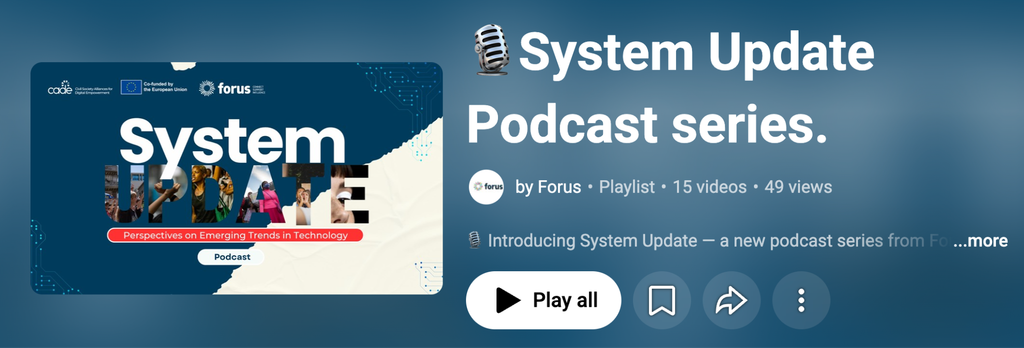
AI and digital technologies are transforming our societies. But who gets to shape the rules? Across 12 episodes, System Update, produced by CADE partner Forus, brings together leading voices from civil society, technology, policy and advocacy to explore the future of AI governance, internet governance and digital rights. Tune in to the playlist to listen to:
- Camila Weinmann and Daniela Rincón (Democracy Reporting International)
- Asma Derja (Ethical AI Alliance)
- Sara Marcucci (AI + Planetary Justice Alliance)
- Mapalo Lukashi (BongoHive)
- Rafik Dammak (ICANN)
- Diya Aravinthan (Better Internet for Kids)
- Agneris Sampieri (Access Now)
- Nenden Sekar Arum (SAFEnet)
- Muhammad Shabbir (Dynamic Coalition on Accessibility and Disability)
- Fernanda K. Martins (Fundación Multitudes)
- Malick Ndome (CONGAD)
- Pedro Muiambo (JOINT – Liga das ONGs em Moçambique)
From democracy and AI ethics to accessibility, platform accountability and civil society leadership, each episode offers practical insights into building a more inclusive and rights-based digital future. Follow the series on YouTube.
Whose voices shape the internet?
CADE partner Karisma has published another video in its internet governance series, examining how some voices can be given greater weight while others are silenced.
Using the metaphor of the internet as a stage, the video asks whether we are merely part of the audience – or whether we get a chance to take the microphone and exercise our rights online with autonomy and freedom. Watch the video.
Whose voices shape the internet?
CADE partner Karisma has published another video in its internet governance series, examining how some voices can be given greater weight while others are silenced.
Using the metaphor of the internet as a stage, the video asks whether we are merely part of the audience – or whether we get a chance to take the microphone and exercise our rights online with autonomy and freedom. Watch the video.

| 📅 COMING UP |
New cycle: CADE’s Digital Governance Working Group | 23 September
CADE’s Digital Governance Working Group begins a new cycle on 23 September at 14:00–15:30 UTC, bringing civil society organisations together to exchange knowledge and experiences on digital governance and explore areas for joint action.
The opening session will focus on CSO needs and pain points in AI governance: Where are the biggest gaps, what support is missing, and which issues should the civil society community take forward together? The discussion will build on existing civil society work and help identify shared priorities for the working group’s programme over the coming months. The session will include simultaneous interpretation in English, French and Spanish.
The working group meets every other month, with its agenda shaped collectively by the organisations involved. New organisations are welcome to join the cycle and bring their own priorities and perspectives to the discussion. Register for the session.
FIFAfrica | 28 September–1 October
The Forum on Internet Freedom in Africa (FIFAfrica), convened by CIPESA from 28 September to 1 October in Mauritius, will bring together stakeholders from across Africa and beyond to discuss privacy, freedom of expression, inclusion, the free flow of information, civic participation, and online innovation. CADE partners will be part of these conversations, bringing civil society perspectives from across the region. Find out more about FIFAfrica.
Bread&Net 2026 | 14–16 October
CADE partner SMEX will convene Bread&Net 2026 in Beirut from 14–16 October under the theme Realities Reimagined. The digital rights unconference will create space to explore alternative infrastructures, governance models, technologies and forms of solidarity and movement building for a more just, sovereign and community-centred digital future in the WANA region. Find out more about Bread&Net 2026.
IGF 2026 | 14–18 December
CADE partners and team members are preparing for IGF 2026 in Nairobi, under the theme Governing the Internet in the Age of Intelligence: Our Shared Responsibility. CADE will bring civil society perspectives from the Global South to discussions on AI, digital inclusion, cybersecurity, digital rights and the future of the internet, while creating opportunities for partners and CSOs to connect and share their work. Planning to be in Nairobi? Get in touch to stay informed about CADE’s activities at IGF 2026.
The Civil Society Alliances for Digital Empowerment (CADE) project is co-funded by the European Union. The views expressed in these initiatives are those of the authors and do not necessarily reflect the official position of the European Union. Contact us at cade@diplomacy.edu.