
Skip to content
CADE – Civil Society Alliances for Digital Empowerment Logo CADE – Civil Society Alliances for Digital Empowerment Logo
  • Topics
  • Policy updates
  • In focus
  • Resources
  • Actors
  • Policy calendar
  • About
    • About project
    • Our mission
    • Latest news & events
    • Who are we?
    • Mapping & baseline
    • Newsletters
    • Join us
  • Partners’ login
  • Topics
  • Policy updates
  • In focus
  • Resources
  • Actors
  • Policy calendar
  • About
    • About project
    • Our mission
    • Latest news & events
    • Who are we?
    • Mapping & baseline
    • Newsletters
    • Join us
  • Partners’ login
  • Topics
  • Policy updates
  • In focus
  • Resources
  • Actors
  • Policy calendar
  • About
    • About project
    • Our mission
    • Latest news & events
    • Who are we?
    • Mapping & baseline
    • Newsletters
    • Join us
  • Partners’ login

What’s next for the Global Digital Compact? Pathways to civil society engagement in the implementation and follow-up

Previous Next

What’s next for the Global Digital Compact? Pathways to civil society engagement in the implementation and follow-up

31 October 2024

As part of efforts to strengthen civil society engagement in digital governance, an online roundtable titled ‘Multistakeholder Cooperation in Implementing the Global Digital Compact’ was held on 31 October 2024. The event was organised by CADE in partnership with the Association for Progressive Communications and the UN IGF Secretariat.

Through two panel discussions, participants examined what effective multistakeholder cooperation looks like in practice during the implementation and review of the Global Digital Compact. The discussions focused on the engagement mechanisms introduced by the Compact, the role of existing multistakeholder processes such as the World Summit on the Information Society and the Internet Governance Forum, and key entry points for civil society to contribute to implementation and follow-up efforts.

Screenshot of the online dialogue held on 31 October 2024
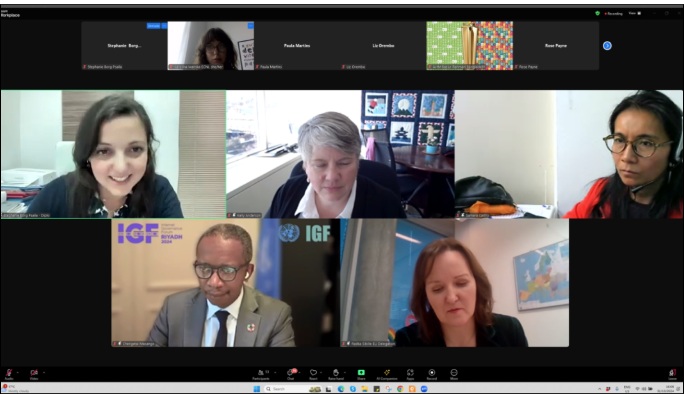
Screenshot of the recorded online dialogue, held on 31 October 2024. Clockwise from top left: Dr Stephanie Borg Psaila, Director of Digital Policy, DiploFoundation (moderator); Ms Kelly Anderson, Director for International Cyber, Digital and Emerging Technology Policy, Global Affairs Canada; Ms Samara Castro, Director, Promotion of Freedom of Expression, Digital Policies Section – Secretariat of Social Communication, Presidency of Brazil; Ms Radka Sibille, Permanent Delegation of the EU to the UN in Geneva; and Mr Chengetai Masango, Head of Office, UN IGF Secretariat

By Boris Begovic|2026-01-28T12:57:22+00:00October54 31, 2024|Latest news|Comments Off on What’s next for the Global Digital Compact? Pathways to civil society engagement in the implementation and follow-up

Civil Society Alliances for Digital Empowerment (CADE) is a project co-funded by the European Union.

Civil Society Alliances for Digital Empowerment (CADE) 2024. All rights reserved.

This website is co-funded by the European Union. Its contents are the sole responsibility of CADE and do not necessarily reflect the views of the European Union.

Web accessibility | Privacy policy

Page load link
We use cookies to improve your experience on our website
By clicking 'Accept' you consent to all cookies in accordance with our Cookie Policy and Privacy Policy. We have updated our Privacy policy effective 27 April 2020 to reflect our expanding online tools and presence.More info

Accept No, thanks
Privacy & Cookies Policy

Privacy Overview

This website uses cookies to improve your experience while you navigate through the website. Out of these, the cookies that are categorized as necessary are stored on your browser as they are essential for the working of basic functionalities of the website. We also use third-party cookies that help us analyze and understand how you use this website. These cookies will be stored in your browser only with your consent. You also have the option to opt-out of these cookies. But opting out of some of these cookies may affect your browsing experience.
Necessary
Always Enabled
Necessary cookies are absolutely essential for the website to function properly. This category only includes cookies that ensures basic functionalities and security features of the website. These cookies do not store any personal information.
Non-necessary
Any cookies that may not be particularly necessary for the website to function and is used specifically to collect user personal data via analytics, ads, other embedded contents are termed as non-necessary cookies. It is mandatory to procure user consent prior to running these cookies on your website.
SAVE & ACCEPT
Go to Top