CADE Newsletter – December 2025
✊ HIGHLIGHT
How the UN’s Universal Periodic Review helps civil society keep governments’ commitments in view
If you work in civil society, you know the pattern: Commitments are made in formal settings, but what happens next can be slow, uneven, or quietly abandoned. The challenge is often the absence of a structured process that calls governments back to the table to follow up on their commitments. That is part of what the Universal Periodic Review (UPR) offers.
The UPR in brief, and where civil society fits
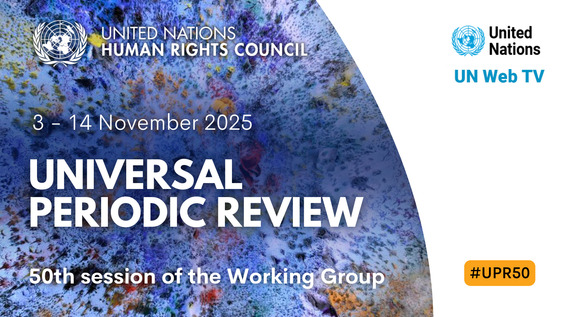
The UPR is a process of the UN Human Rights Council in which every member state’s human rights record is reviewed on a regular cycle. Think of it as a scheduled moment when a government has to explain publicly what it has done, what it has not done (yet), and what it plans to do next. Other governments take turns asking questions and making recommendations, and the country under review responds.
In brief, it’s like a structured progress meeting that repeats every few years. That predictability matters, because when a commitment is written down as a UPR recommendation, it becomes easier for civil society to track: Was it accepted? Was anything done? What changed? What stayed the same? Over time, the UPR creates a paper trail that is useful precisely because it is official, routine, and comparable from one cycle to the next.
Civil society is not in the room as a reviewing state, but it is very much a part of how the UPR works. One of the three documents that shape each review is a UN summary of stakeholder input. This is built from written submissions by civil society organisations, national human rights institutions, and others.
CADE’s UPR submissions: CIPESA on Rwanda and Liberia, SMEX on Lebanon
In November, two partners contributed stakeholder submissions that will inform upcoming reviews – adding documented evidence and recommendations to the UPR record.
CIPESA worked with partners to prepare four stakeholder submissions for the UPR 2025 cycle: three focused on Rwanda’s human rights record in the digital context, and one linked to Liberia’s review.
The Rwanda submissions note reforms and new institutions, while also documenting the gap between policy and lived experience, particularly around online expression, surveillance and oversight, and access to independent information. They also track who is most affected when the digital environment becomes more restrictive: journalists, online commentators, women in public life, and communities facing structural barriers to access. CIPESA also contributed to UPR pre-sessions, delivering a joint statement in Geneva last month.
Against a backdrop of pressure on connectivity and online space, SMEX’s policy team submitted two separate UPR stakeholder submissions for Lebanon, in collaboration with Access Now and APC.
The submissions outline concrete, evidence-based recommendations on digital rights, including freedom of expression online, access to information, and safeguards against unlawful or disproportionate interference online.
How to engage: The UPR entry points
There are a few clear entry points that tend to work best when they are treated as steps in a cycle rather than a one-off moment:
- Before the review: Submit a focused stakeholder report that presents credible evidence and practical recommendations (often more effective as a coalition).
- During the run-up: Brief diplomatic missions and share short, plain-language notes on what matters and what to ask for.
- Upon adoption: Accredited NGOs can make a short public statement when the outcome is adopted by the Human Rights Council.
- Between cycles: Track accepted recommendations, publish updates, and use the UPR record as a steady reference point at the national level.
UPR Working Group 51
• Date: 19 January 2026
• States under Review:
Micronesia (Federated States of), Lebanon, Mauritania, Nauru, Rwanda, Nepal, Saint Lucia, Oman, Austria, Australia, Saint Kitts and Nevis, Sao Tome and Principe, Georgia
HRC 61: Adoption of UPR reports
• Date: February 2026
• States: Belarus, Liberia, Malawi, Mongolia, Panama, Maldives, Andorra, Bulgaria, Honduras, Marshall Islands, Croatia, Jamaica, Libya
If you’re considering UPR engagement, visit the official UN Human Rights Council Universal Periodic Review website or read the UPR’s December newsletter to learn about the current cycle, and get in touch with us for practical advice. CIPESA’s input was made possible thanks to the support of the European Union through the CADE project.
📎 PUBLICATIONS
Our new resources: Entry points into global processes and technical bodies
Speaking of engagement, CADE partner ECNL has published two practical resources aimed at organisations looking to understand where participation is possible and how to approach it.
Getting started in digital governance
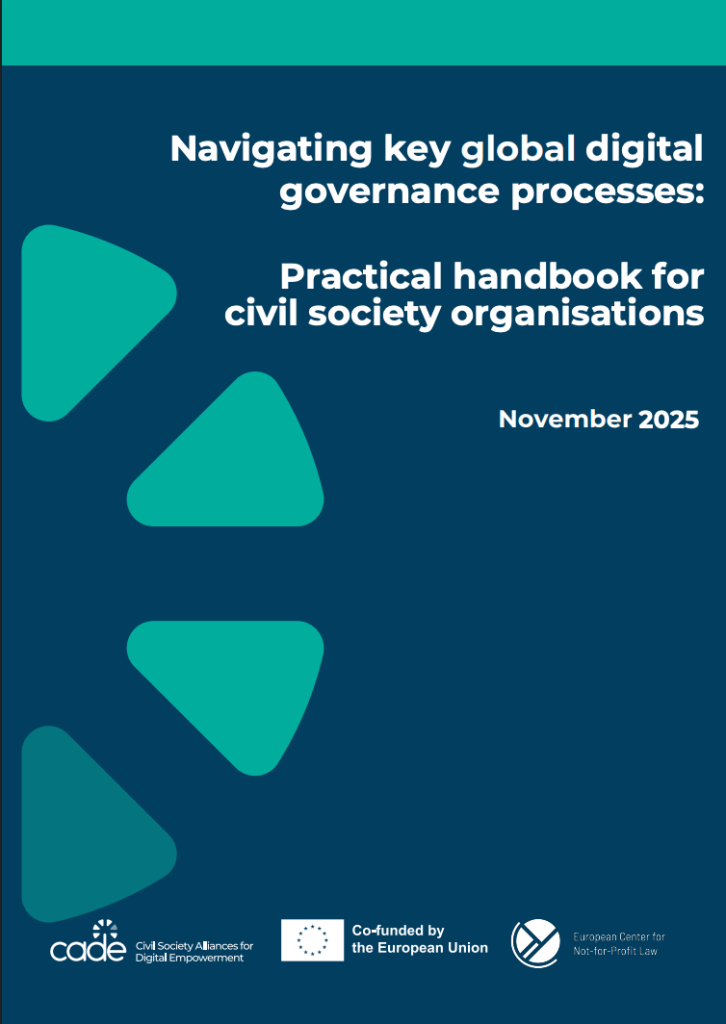
If you’re new to digital governance, ECNL’s first publication explains how CSOs can get involved with key global processes that shape our digital future. It offers practical tips for engaging with the UN General Assembly, the World Summit on the Information Society (WSIS), and the Freedom Online Coalition: How can a CSO participate and generate an impact? What are the upcoming opportunities to do so? Download the handbook.
Engaging with technical bodies
If you and your organisation are already more technically savvy, check out a four-part explainer on how to engage with ICANN, the IETF, ITU, and the IGF – technical and governance bodies that shape how people around the world access the internet. Download the explainers.
🌍 REGIONAL HIGHLIGHTS
From learning to action: Youth-led stories on digital rights
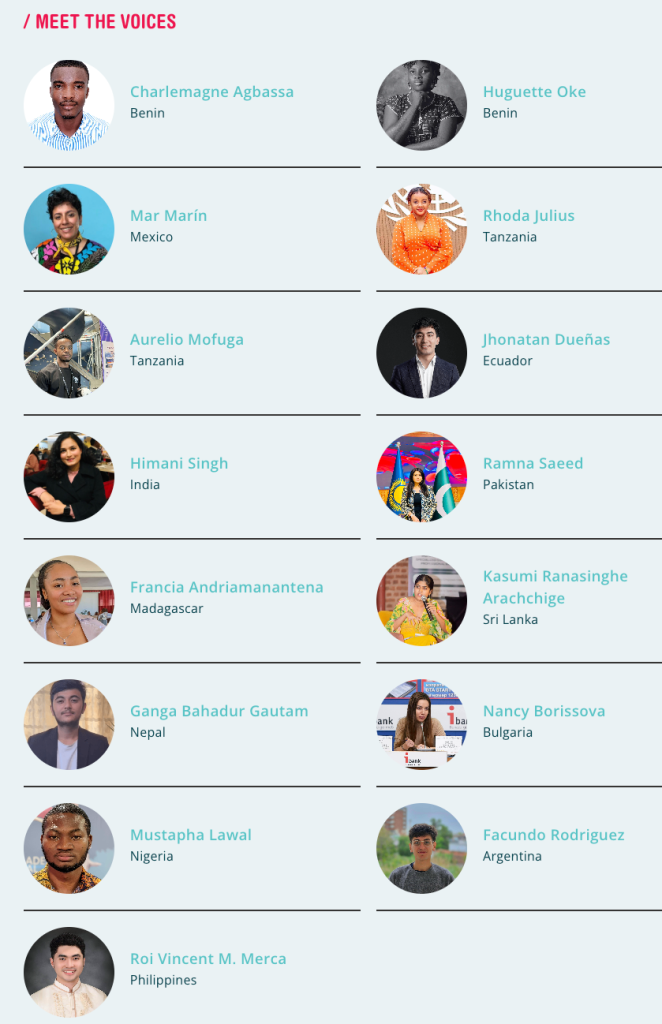
Through the CADE Youth Voices for Digital Rights initiative, led by Forus in partnership with Fundación Karisma, 15 young advocates from Africa, Asia, Latin America, and Europe have spent the past months learning, collaborating, and taking action on digital rights. They also received support to explore how digital technologies affect their rights and communities.
The young activists have been producing creative multimedia projects – including videos, podcasts, and visual storytelling – to spread awareness on community data sovereignty, children’s rights online, internet shutdowns during elections, and digital surveillance and civic freedoms, among other topics.
For instance, Kasumi Ranasinghe Arachchige, one of the 15 activists, explains what data colonialism looks like in the small island of Mannar, Sri Lanka, and how the extraction and use of data affect the island’s local community and their rights.
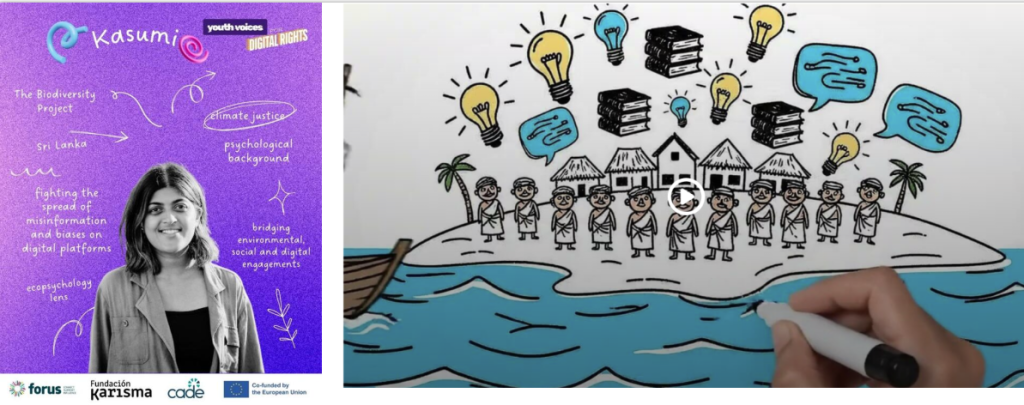
Kasumi Ranasinghe Arachchige from Sri Lanka
Young activist Facundo Rodriguez reflects on youth protests in Argentina, placing them in the wider context of Generation Z movements worldwide and exploring how young people organise and make their voices heard, even when civic space is restricted.
📅 COMING UP
Launch of the Youth Manifesto: Meet the Voices
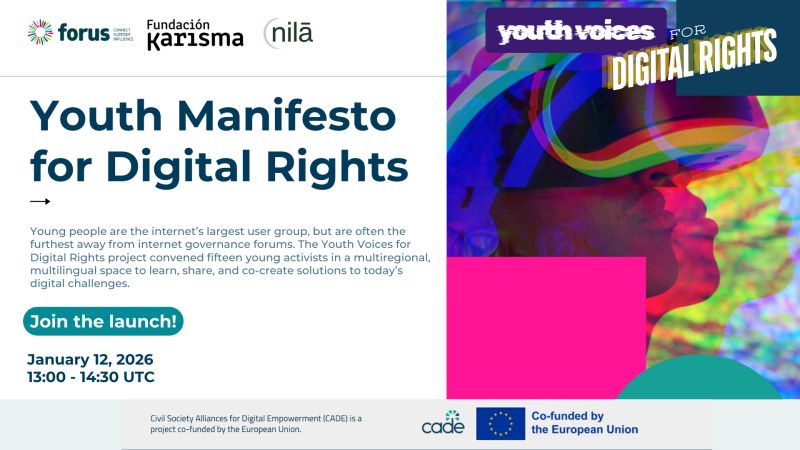
On 12 January 2026, CADE will host a virtual open house to launch the Youth Manifesto on Digital Rights and showcase participants’ work. Register and be part of the conversation: Discuss directly from young leaders and add your voice to a growing movement for rights-respecting digital futures.
Over 60 CSOs join CADE’s online capacity building programme
CADE’s Capacity Development Programme for CSOs 2025–2026, delivered by DiploFoundation, launched in December with the technical skills component, bringing together over 60 civil society organisations.
The programme, funded by the EU, offers a comprehensive training pathway to strengthen CSOs’ ability to engage more effectively in digital policy processes. It begins with foundational digital policy knowledge and moves into specialised topics such as internet infrastructure, cybersecurity, and AI policy, before concluding with diplomatic skills including negotiation and coalition-building.
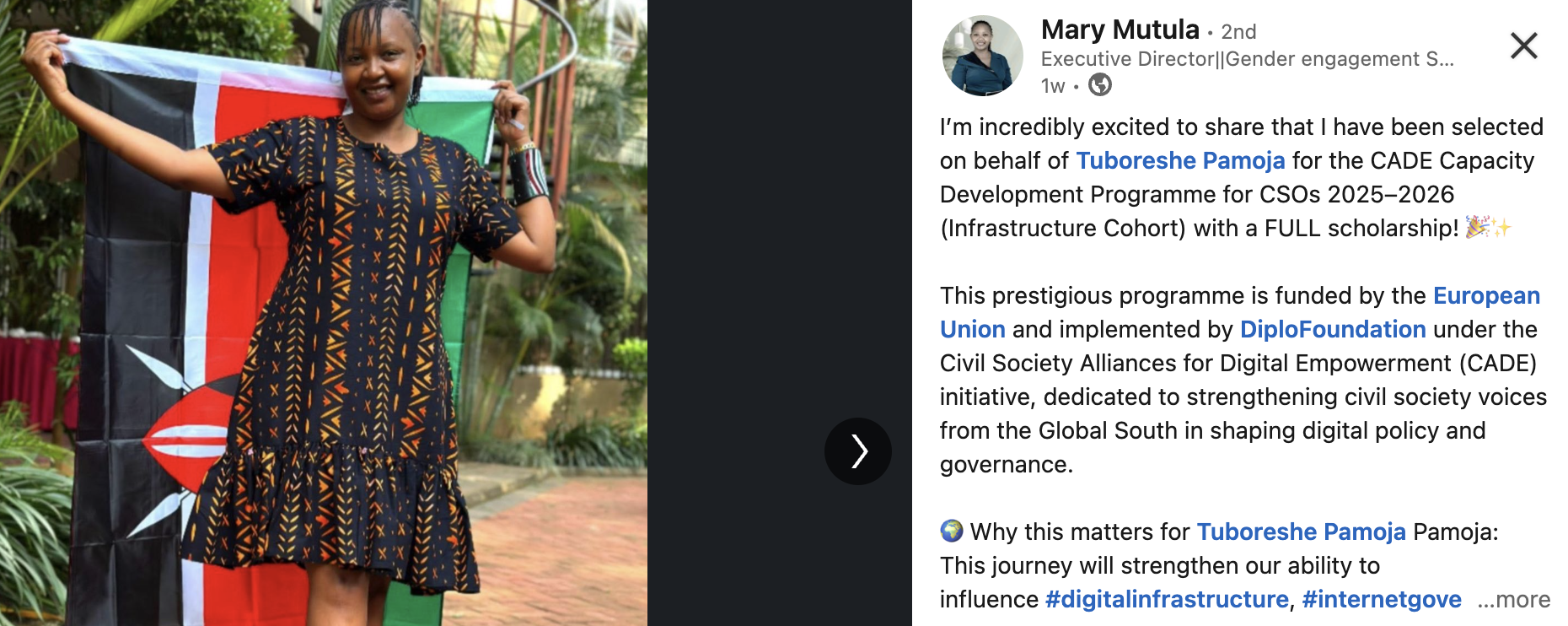
Kicking off strong: One of the many voices joining CADE’s Capacity Development Programme for CSOs as the technical skills component gets underway
📊 2025 IN REVIEW
CADE on the global stage: How we shaped digital policy debates in 2025
In 2025, CADE positioned civil society voices at key global and regional digital governance forums, ensuring that CSO perspectives were represented where internet policy agendas are shaped. Partner organisations, increasingly interested in integrating these issues into their agendas, also joined, bringing new voices into the ecosystem.
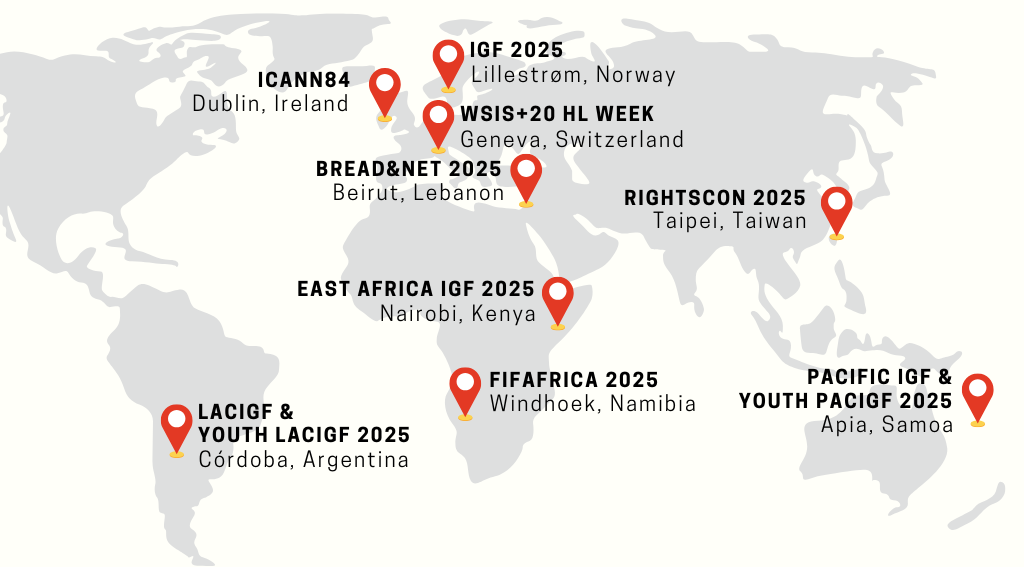
Internet Governance Forum (IGF) 2025 – Lillestrøm, Norway
At the year’s largest global gathering of the digital policy community (with more than 8,000 participants from governments, civil society, the private sector, academia, and the technical community, in person and online), we leveraged the forum to strengthen civil society presence in multistakeholder digital governance. Through strategic exchanges with civil society networks, technical actors and institutions, we advanced cross-regional collaboration and kept human rights priorities on the agenda.
LACIGF and Youth LACIGF – Córdoba, Argentina
During the Latin American and Caribbean IGF gathering, we helped expand and diversify participation in regional internet governance discussions. Through targeted support for newcomers and engagement in key sessions, CADE’s presence reinforced multistakeholder approaches and brought rights-based perspectives into regional debates, including on gender and internet restrictions.
Pacific IGF 2025 – Apia, Samoa
In the Pacific, we highlighted locally grounded approaches to digital inclusion, digital literacy, trust and transparency, and multistakeholder collaboration, while also supporting the first Pacific Youth IGF, expanding opportunities for young people to engage in regional internet governance discussions.
East Africa IGF 2025 – Nairobi, Kenya
At the EAIGF, we focused on Global South CSO capacities, creating space for practical exchange on how civil society can engage more effectively with global internet governance and standards bodies (including ICANN, the IETF and ITU), build principled partnerships, and strengthen sustainable participation.
ICANN84 – Dublin, Ireland
At ICANN84, we collaborated with the Non-Commercial Stakeholder Group (NCSG) to contribute to policy discussions at the heart of the domain name system (DNS) ecosystem, examining how measures such as DNS blocking intersect with human rights and online accountability. We also facilitated the participation of new CSOs from the MENA region to engage directly with ICANN spaces and better understand how internet infrastructure decisions shape rights in practice.
WSIS+20 High-Level Week – Geneva, Switzerland
During WSIS+20 High-Level Week, a key milestone in the global review of digital cooperation, we helped shape conversations on the future of internet governance by convening an informal dialogue on strengthening civil society engagement in policy and standards-setting spaces. The exchange brought together civil society, the technical community and the private sector to address barriers to participation and explore more inclusive, trust-based collaboration, alongside strong visibility and strategic networking.
FIFAfrica 2025 – Windhoek, Namibia
At FIFAfrica 2025, we focused on strengthening advocacy pathways for digital rights across Africa, leveraging the Universal Periodic Review (UPR), linking global human rights mechanisms with digital rights priorities, and supporting CSOs to turn lived challenges into stronger national and international advocacy.
Bread&Net 2025 – Beirut, Lebanon
At Bread&Net, we supported one of the region’s key convenings on digital rights by contributing practical capacity-building for civil society. The sessions helped organisations strengthen their entry points into internet governance and multistakeholder processes, while creating space for regional dialogue on urgent policy developments affecting rights online.
RightsCon 2025 – Taipei, Taiwan
At RightsCon 2025, we convened a hands-on civil society workshop on the WSIS+20 Review and meaningful multistakeholder engagement in internet governance, creating a practical space for organisations, including newer voices from the Global South, to align on the process, coordinate strategies, and develop contributions.
Our impact in numbers






We wish you a joyful holiday season and a prosperous 2026 filled with collaboration, learning, and continued progress in advancing digital rights worldwide!
This publication was co-funded by the European Union. Its contents are the sole responsibility of CADE and do not necessarily reflect the views of the European Union.