

CIPESA’s role in advancing digital rights through the Universal Periodic Review
The Universal Periodic Review (UPR) is a core accountability mechanism of the United Nations Human Rights Council (UNHRC). It examines the human rights performance of every UN member state on a rotating basis. Each country undergoes a review approximately once every four and a half years. The UPR process relies on three information sources. These are a national report from the state under review, a compilation of UN system information prepared by the Office of the High Commissioner for Human Rights (OHCHR), and a stakeholder report informed by civil society organisations. Together, these form the basis of a structured dialogue in Geneva during which states ask questions, raise concerns, and issue recommendations. The Human Rights Council (HRC) subsequently adopts an outcome document.
Civil society plays a crucial role in ensuring that the UPR reflects on-the-ground realities, rather than relying solely on government narratives. Stakeholder submissions document long-standing issues, highlight perspectives from affected communities, and identify emerging human rights risks, including those associated with digital technologies. The cycle also facilitates coalition building, coordinated advocacy, and follow-up at both national and regional levels.
CIPESA’s engagement in the 2025 review cycle
The Collaboration on International ICT Policy for East and Southern Africa (CIPESA), a CADE partner organisation, used the 2025 UPR cycle to advance evidence-based advocacy on digital rights across the continent. CIPESA prepared four submissions in collaboration with partner organisations. Three addressed Rwanda’s human rights record in the digital context, and one of these formed part of the review of Liberia.
UPR submissions on Rwanda
Rwanda entered its fourth UPR cycle having received 284 recommendations during the January 2021 review. Of these, 160 recommendations were accepted. Many are related to civic space, media freedoms, protection of privacy, equal participation, and access to information. Rwanda has introduced several reforms since 2021. These include the adoption of the Data Protection and Privacy Law (Law No. 058/2021), strengthening the Rwanda National Cyber Security Authority, expansion of e-government through the Irembo platform, and digital inclusion initiatives under the National Strategy for Transformation. Rwanda has also promoted digital literacy through the Digital Ambassadors Programme and made notable progress in expanding women’s access to digital financial services.
However, persistent challenges remain. Restrictions on freedom of expression, surveillance practices, and barriers to access to independent information continue to limit online civic space. Criminal provisions related to defamation, public order, and national security have been applied against journalists, bloggers, and activists. There are continued reports of harassment, arrests, and intimidation. Some diaspora and opposition content has been blocked. Women journalists and activists face gendered online attacks and marginalised groups experience digital exclusion due to high internet costs, lack of accessibility for persons with disabilities, and socioeconomic barriers. Organisations have documented evidence of pro-government trolling and the use of AI-generated content to discredit critics.
1. Joint Submission by CIPESA and the Pan African Lawyers Union (17 July 2025)
This report assesses Rwanda’s performance across key digital rights issues since its 2021 UPR. It finds that although Rwanda has adopted progressive legislation and improved digital service delivery, significant restrictions remain in practice. Journalists and online commentators continue to operate within a climate of fear. Access to official information is inconsistent. Online harassment, including against women, persists.
The full report is available at the following link.
2. Joint Submission by Small Media Foundation, ARTICLE 19, CIPESA, and the University of Birmingham (23 July 2025)
This submission evaluates progress against Rwanda’s UPR Implementation Roadmap for 2021 to 2026. It concludes that Rwanda has made limited progress in reforming restrictive laws or implementing safeguards against arbitrary surveillance. Criminalisation of journalists and intimidation of critics continue. Access to information remains insufficient, and media regulation lacks independence. The report recommends law reform, decriminalisation of defamation, stronger oversight of cybersecurity and data governance, protections for bloggers and citizen journalists, and full implementation of access-to-information obligations.
The full report is available at the following link.
3. Joint stakeholder report: Human rights in the digital context in Rwanda, by CIPESA and the Association for Progressive Communications (APC) (26 September 2025 | Updated 5 November 2025)
Updated in November 2025, this submission focuses on online freedom of expression, privacy, digital inclusion, surveillance, transnational repression, and technology-facilitated gender-based violence. It recommends investments in broadband infrastructure, community networks, mentorship programmes for girls in ICT, and improved device access for marginalised groups. It also outlines steps for reforming restrictive legislation, ensuring independent oversight of surveillance, and strengthening legal and institutional responses to TFGBV.
The full report is available at the following link.
CIPESA’s contribution to UPR pre-session 51 (Geneva, 26–28 November 2025)
The UPR pre-sessions are organised to allow civil society organisations to brief UN member states before the formal UPR Working Group review. CIPESA and APC delivered a joint statement on 27 November 2025. It presented emerging findings from their stakeholder consultations and analysis.
The statement addressed four priority themes:
• Freedom of expression online
• Surveillance, privacy, and lack of independent oversight
• The gender digital divide and structural digital exclusion
• Technology-facilitated gender-based violence against women public figures and activists
The statement underscored that implementation of recommendations from Rwanda’s 2021 UPR cycle remains limited. Restrictive laws remain unchanged. Journalists continue to face harassment. Surveillance occurs without independent oversight. Women continue to face disproportionate barriers to participation and heightened online harms. The intervention outlined recommendations to repeal or amend restrictive laws, regulate surveillance tools, strengthen safeguards for journalists and human rights defenders, improve digital access for marginalised groups, and build robust frameworks to prevent and respond to TFGBV.
Full statement is available here. A factsheet summarising key issues from previous cycles is also available for consultation.
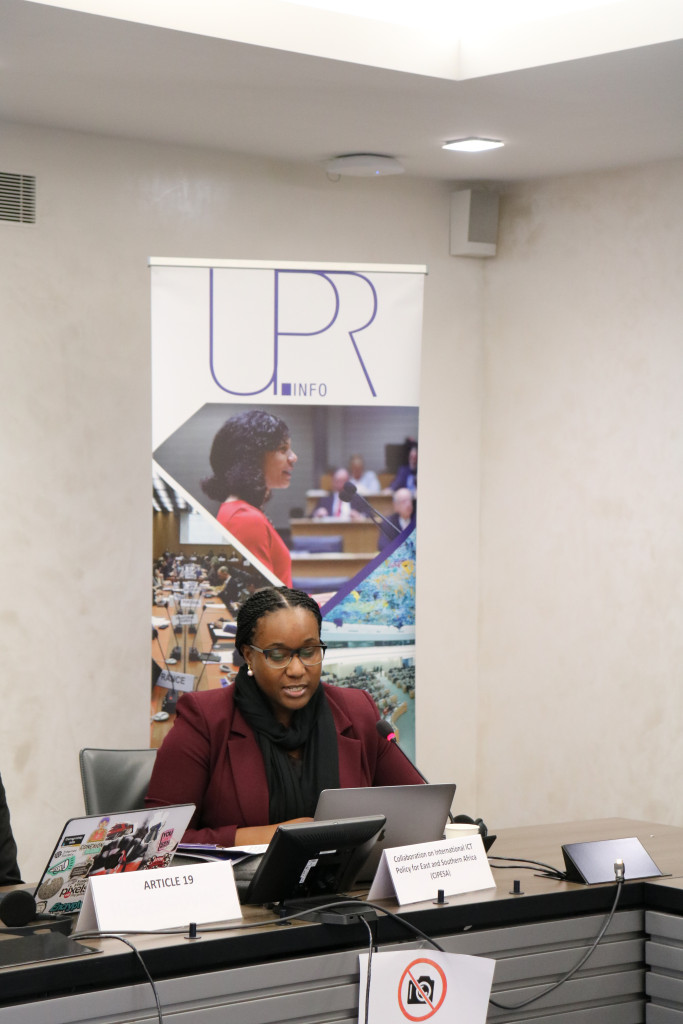
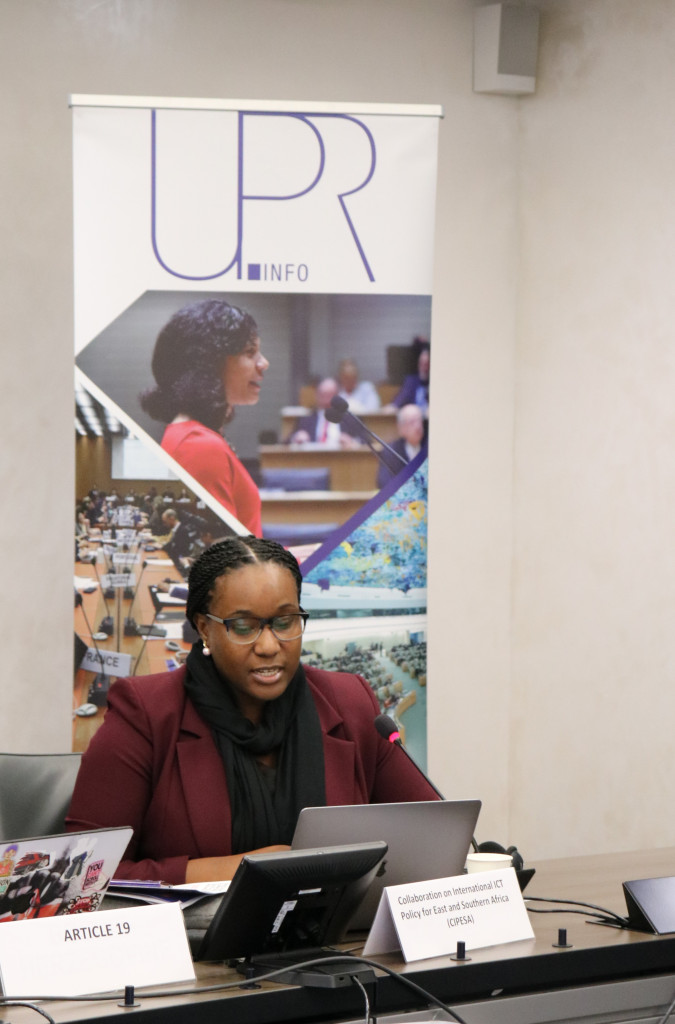
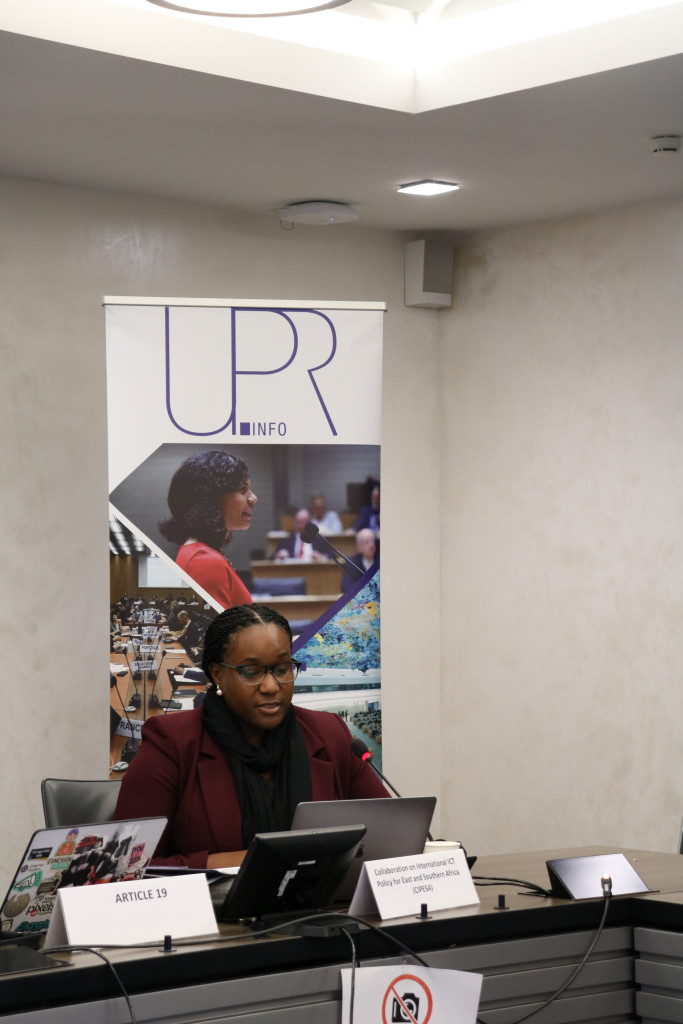
CIPESA’s Patricia Ainembabazi delivering the Statement on the UPR Pre-Session 51 on the Republic of Rwanda (Digital Rights), 27 November 2025, Geneva, Switzerland.
UPR submission on Liberia
Beyond Rwanda, CIPESA worked with the West Africa ICT Action Network (WAICTANET) to prepare a joint stakeholder report for Liberia’s review at the 50th UPR session. Liberia enters its fourth UPR cycle after receiving 218 recommendations during the 2020 review. Only two addressed digital rights. The country has since made progress in certain areas, including the decriminalisation of defamation, the introduction of draft data protection legislation, and improvements in online child protection.
However, persistent challenges continue to constrain Liberia’s digital civic space. These include attacks against journalists, threats and intimidation of online commentators, partial censorship of public interest reporting, weak implementation of the Freedom of Information Act, the absence of a comprehensive data protection law, and widespread digital exclusion that disproportionately affects rural communities, women, and marginalised groups.
The joint submission finds that while Liberia has taken steps toward harmonising domestic law with international human rights standards, gaps remain significant. It recommends the adoption of robust data protection and cybersecurity legislation, protections for online expression, strengthened accountability for violations committed against journalists and human rights defenders, improved transparency in access to information, and targeted measures to expand digital inclusion.
The joint CIPESA–WAICTANET submission is available at the following link. link.
CIPESA’s work on each of the above submissions was supported by the Civil Society Alliances for Digital Empowerment (CADE), a project co-funded by the European Union. The contents of the joint submissions, statements, and this page are the sole responsibility of CIPESA and do not necessarily reflect the views of the European Union or the partners of the CADE project.
