
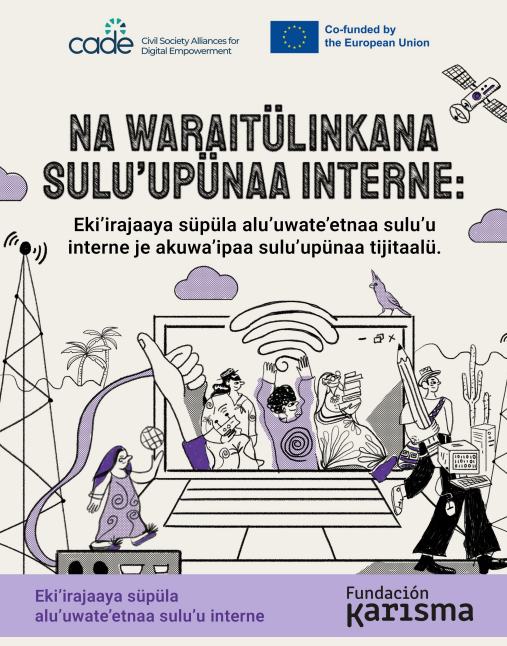
Na Waraitülünkanana Sulu’upünaa Internet: Ekï’irajaaya süpüla alu’uwate’etnaa sulu’u interne je akuwai’ipaa sulu’upünaa tijitaalü.
October 2026
Manuals and Handbooks
Executive summary
Publication: September 2025
Translated in October 2026
This publication is also available in Spanish.
This publication is also available in Portuguese.
Internet navigators: A Training cycle on internet governance and digital citizenship is a training publication produced by Fundación Karisma within the framework of the Civil Society Alliances for Digital Empowerment (CADE) project, co-funded by the European Union. Published in October 2026 in Wayuunaiki, the document serves as an educational resource to support capacity development in internet governance and digital citizenship, particularly for young people, rural educators, and historically excluded communities in Latin America and the Caribbean.
The publication is structured as a three-module training cycle. The first module explains how the internet works, covering basic infrastructure, data transmission, protocols, encryption, and the layered model of the internet through accessible examples. The second module examines internet governance, focusing on decision-making actors, technical and policy spaces, and practices such as censorship, filtering, DNS manipulation, and internet shutdowns, and their implications for human rights. The third module addresses the digitalisation of public services, analysing how state-led digital transformation affects access to rights, inclusion, territorial inequalities, and digital sovereignty.
Across all modules, the publication frames internet governance as a rights-based issue rather than a purely technical one. It links global governance processes with local experiences and provides conceptual explanations and practical tools to help readers understand, analyse, and engage with decisions that shape the digital environment. The overall objective of the publication is to strengthen informed participation and advocacy in internet governance debates from a human rights and inclusion perspective.
This publication was co-funded by the European Union. Its contents are the sole responsibility of the author and do not necessarily reflect the views of the European Union.